Al Gregory
The Big SleepAl Gregory, also called Captain Gregory, is a burly, deliberate officer in the Missing Persons Bureau whose investigation of Terence Regan’s disappearance gives Philip Marlowe an essential official account of the missing man’s car and the possible connection to Mona Mars. Gregory’s files provide facts, but his cautious handling of them also shows how an inquiry’s meaning can depend on what the police know, what they can establish, and what they choose to disclose.
Identity and Introduction
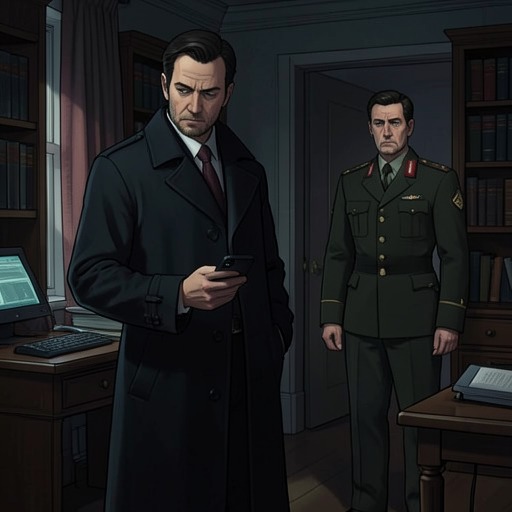
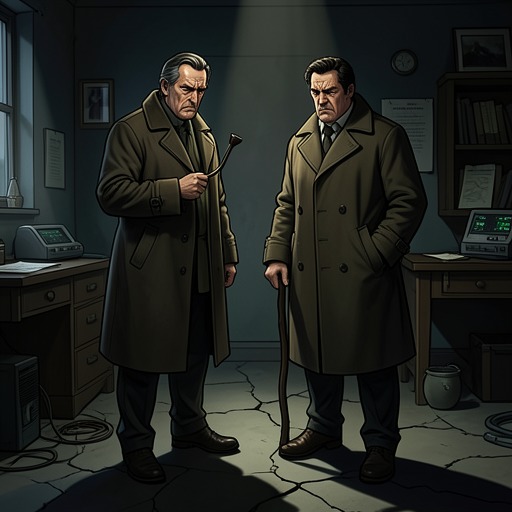
Marlowe finds Gregory at the Missing Persons Bureau, seated behind a broad desk in the Hall of Justice. The narration presents him as heavy-set and tired-eyed, with slow, deliberate movements and a flat, uninterested voice. His careful arrangement of Marlowe’s card and unhurried pipe-smoking reinforce an institutional manner that is neither openly hostile nor immediately welcoming.
Gregory recognizes the name of Bernie Ohls, the district attorney’s chief investigator, and phones him before discussing the case. He asks Ohls to confirm who Marlowe is and what he looks like, then waits for the response before proceeding. The call establishes that Gregory does not treat a private investigator’s request as sufficient authority on its own; he checks Marlowe’s standing through a trusted professional contact.
The Regan File
When Marlowe asks about progress, Gregory identifies Regan as the subject and retrieves a tabbed green case file. He explains that Regan disappeared on September 16, a day when the chauffeur was off duty. No one saw Regan take his car, and the vehicle was found four days later in a garage at Casa de Oro, a bungalow-court property near Sunset Towers. A garage employee reported that the car did not belong there.
The police could not determine who had put the car in the garage, and its prints did not match any prints on file. Gregory says the abandoned vehicle did not, by itself, fit a foul-play explanation, even though the investigators had reasons to suspect foul play. The same evidence could support another interpretation, and Gregory introduces that possibility through the disappearance of Eddie Mars’s wife.
The police established that Mrs. Mars had been living at Casa de Oro and had left around the time Regan disappeared, within roughly two days. Someone resembling Regan had reportedly been seen with her, but investigators could not confirm the identification. Gregory’s account thus gives Marlowe a concrete overlap in time and place without turning an uncertain sighting into proof that Regan and Mrs. Mars left together.
Investigation and Professional Relations
Gregory’s procedure combines an official record with guarded conversation. He checks Marlowe’s identity through Ohls, consults the file, and then relates what the investigators have learned while distinguishing established details from unresolved questions. His account is useful precisely because it does not eliminate uncertainty: the car’s location, the timing of Mrs. Mars’s departure, and the reported sighting form a suggestive pattern, but not a conclusive identification.
Marlowe later explains that his conversation with Gregory helped him understand the police’s role in the Regan inquiry. After Vivian Regan mentioned that “they” had found the car, Marlowe inferred that the police knew something about the disappearance and that the Missing Persons Bureau would have the case. He also reasoned that the authorities might know more because Regan’s chauffeur had a police record. In that sense, Gregory’s bureau becomes a hinge between Marlowe’s private investigation and the official investigation, even when Marlowe cannot know the full extent of the police’s information.
Narrative Role and Significance
Gregory helps shift the investigation from the apparent question of where Regan went to the competing stories that might explain his disappearance. The abandoned car and Mrs. Mars’s presence at Casa de Oro invite the possibility of a shared departure, but the lack of fingerprints and a positive identification keeps that possibility unverified. Gregory’s evidence advances the mystery without resolving it, sustaining the gap between a plausible account and a demonstrable one.
His limited, procedural presence contrasts with Marlowe’s interpretive work. Gregory supplies the contents of the file; Marlowe reads those contents alongside clues and conversations gathered elsewhere. Through this exchange, the novel shows that official information can clarify a chronology while leaving its central human question open: the police can locate a car and record a reported sighting, yet still cannot establish what happened to Regan.